Affiliate Disclosure: Some links are affiliate links, meaning we may earn a commission if you purchase—at no extra cost to you. Prices and availability can change. We base our content on independent research, not direct input from manufacturers or utilities unless stated. Unless explicitly stated, we do not personally test every product. Our reviews are based on independent research, product documentation, and user/reviewer feedback.
Find out exactly where your electricity bill is going — and fix it.
⚡ Key Takeaways
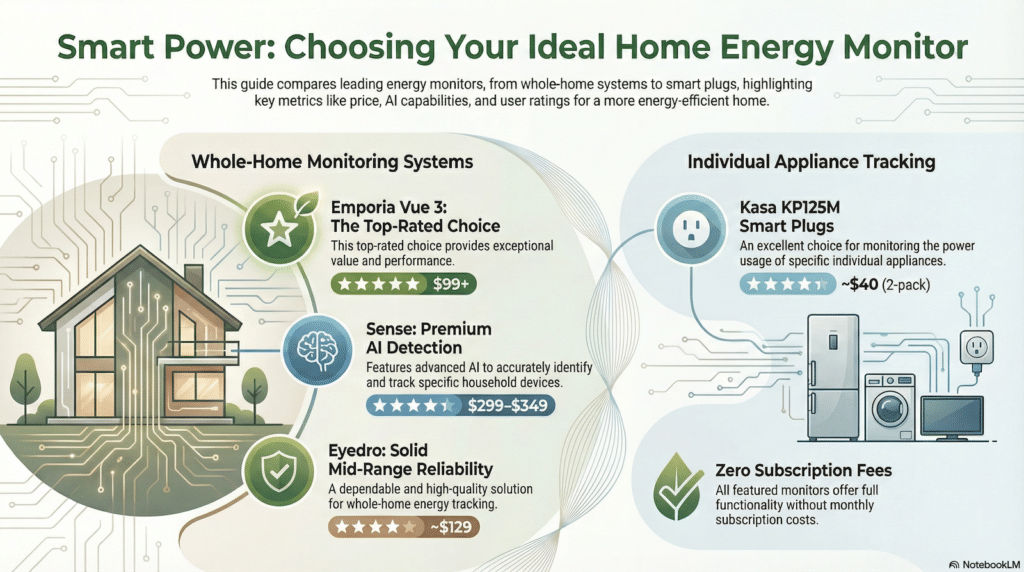
- Best overall: Emporia Vue 3 (from $99) — best balance of price, accuracy, and features for most homeowners.
- Best premium option: Siemens Inhab (~$299) — circuit-level monitoring with whole-home + 16 dedicated sensors, UL Listed, advanced TOU and solar management, and no subscription.
- Best for no-subscription whole-home monitoring: Eyedro EYEDRO-HOME (~$129) — reliable monitoring with free lifetime cloud access and a unique wired Ethernet option.
- Best budget/plug-in option: Kasa KP125M smart plugs (~$40 for 2-pack) — the easiest no-installation entry point for appliance-level monitoring.
- None of the top picks charge ongoing subscription fees.
- Whole-home monitors require installation inside your electrical panel — a licensed electrician is strongly recommended.
- Average users save 8–10% or more on their electricity bills after installing a home energy monitor.
Why You Need a Home Energy Monitor in 2026
The average American household now spends over $2,000 per year on energy costs, and rates have continued climbing. Yet most people have no idea which appliances are responsible for the biggest chunks of their bill — the monthly statement from your utility company tells you what you owe, not why.
That is where a home energy monitor comes in. These devices install into your electrical panel (or simply plug into a wall outlet) and give you a real-time, detailed breakdown of your home’s electricity consumption. They show you which appliances are the biggest energy hogs, send alerts when something is running too long, and can even help you optimize for time-of-use electricity rates.
In this guide, we cover the best home energy monitors available in 2026 — with verified specs, real pricing, honest pros and cons, and clear recommendations based on different homeowner needs.
Quick Comparison: Best Home Energy Monitors at a Glance
Prices verified February 2026. Check links below for current pricing as they may change.
The Best Home Energy Monitors of 2026: Full Reviews
1. Emporia Vue 3 — Best Overall
Price: From $99 (whole-home only) | $149 (with 8 sensors) | $199.99 (with 16 sensors)
Type: Whole-home panel monitor
Subscription: None — app and cloud access are free
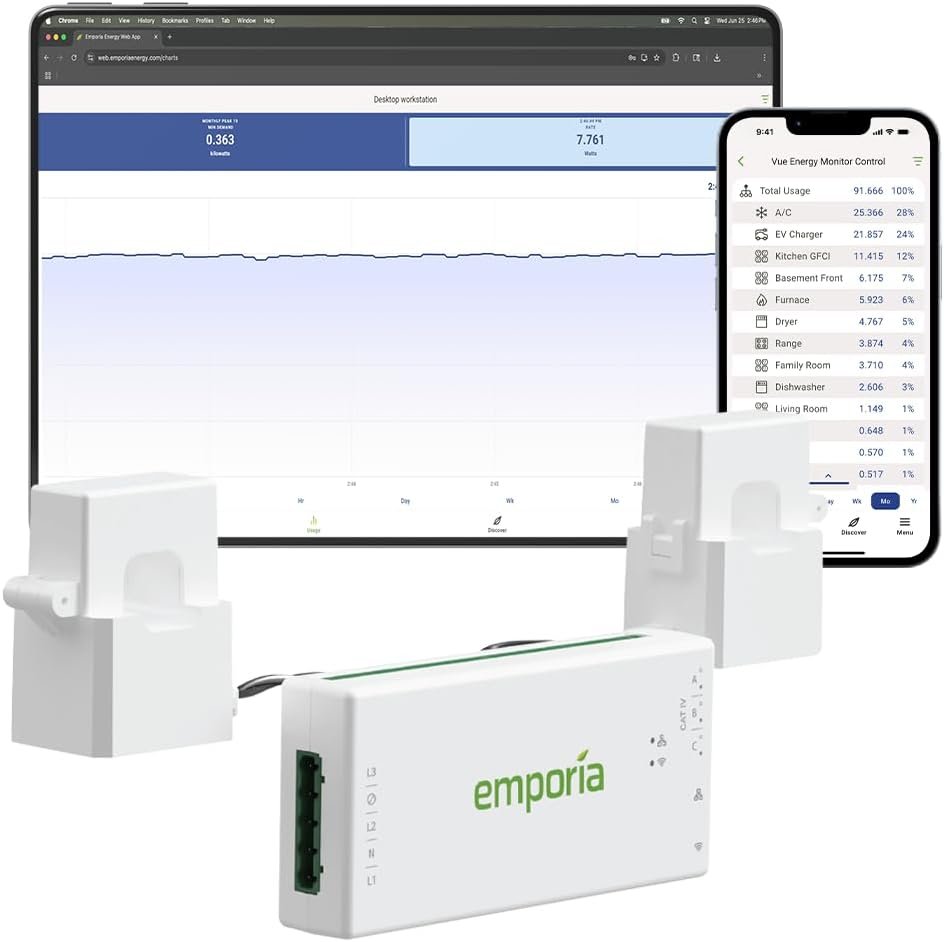
The Emporia Vue 3 is the most recommended home energy monitor on the market right now, and for good reason. It offers the best balance of price, features, and accuracy of any whole-home monitor available, and it starts at just $99 — far less than comparable options.
The Vue 3 installs in your home’s electrical panel using clamp-on current transformer (CT) sensors that wrap around your main service lines. From there, it sends real-time data to the free Emporia Energy app, where you can see your home’s total power draw updated every second.
Where the Vue 3 stands out is its scalability. The base model gives you whole-home monitoring for overall consumption. Add 8 branch sensors ($149 tier) and you can track individual circuits like your HVAC, dryer, or EV charger. Go all the way up to 16 branch sensors ($199.99 tier) and you get a complete picture of everything running in your panel. Emporia claims accuracy within ±2%, which is in line with utility-grade metering.
The Vue 3 also integrates with Emporia’s broader smart home ecosystem — including their smart plugs, EV chargers, and home battery systems — and supports third-party device automation through the app. Solar and net metering are built in. It is UL certified and supports Home Assistant for the DIY crowd.
What we like:
- Lowest starting price of any whole-home monitor ($99)
- Scalable — add up to 16 circuit sensors as your needs grow
- 1-second real-time data in the app
- Solar and net metering support built in
- Free app and cloud access — no subscription ever
- UL certified for safety
- Compatible with Home Assistant
What to know:
- Requires an internet connection — no local data storage
- Professional electrician installation is recommended
- Only 2.4 GHz Wi-Fi (no 5 GHz support)
- 1-second data only retained for 3 hours; minute data retained 7 days
Bottom line: If you want the best whole-home energy monitor for the money, the Emporia Vue 3 is the clear choice in 2026. Start with the $99 base model and add sensors as needed.
2. Siemens Inhab — Best Premium Whole-Home Monitor
Price: ~$299 (INHEM1216 — includes 2×200A main sensors + 16×50A circuit sensors)
Type: Whole-home panel monitor with full circuit-level sensing
Subscription: None
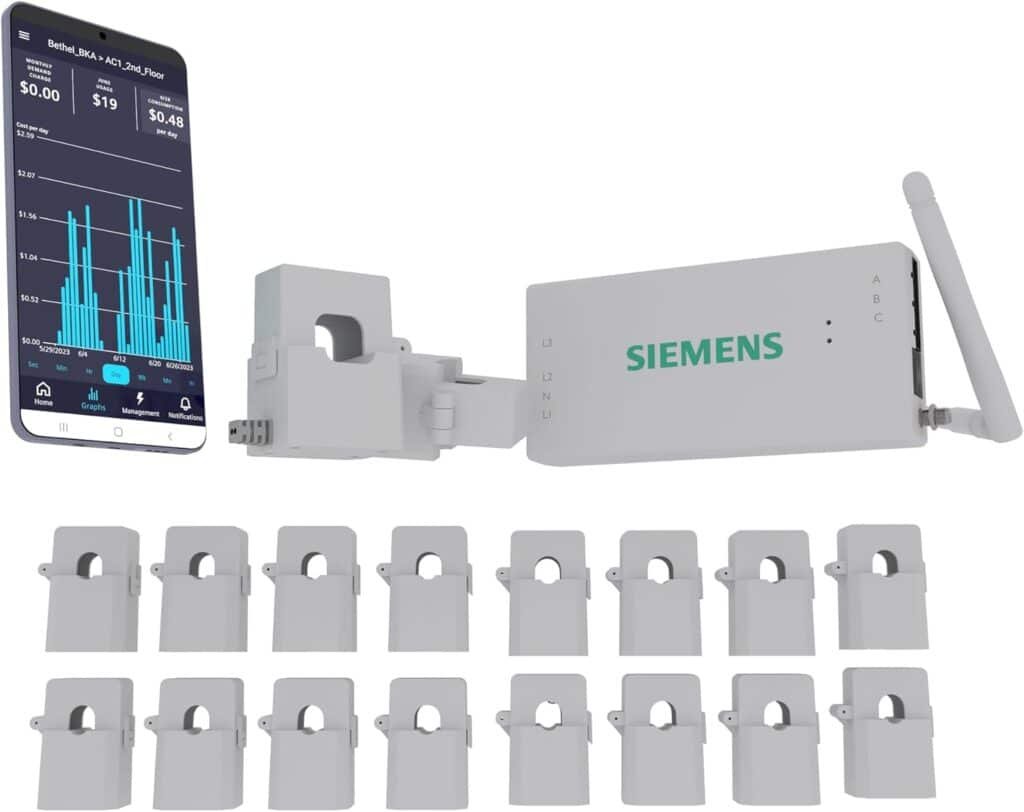
If the Emporia Vue 3 is the smart choice for budget-conscious buyers, the Siemens Inhab (model INHEM1216) is the premium choice for homeowners who want everything included right out of the box — no upsells, no tiered configs, just a complete 16-circuit monitoring system from a name brand that’s been in electrical panels for decades.
The Inhab comes bundled with two 200A main current transformers and sixteen 50A branch circuit sensors, giving you immediate whole-home and circuit-level data from the day it’s installed. No waiting for AI to learn your appliances, no guessing — the Inhab directly measures energy at each circuit you connect. It covers your furnace, air conditioner, water heater, washer, dryer, EV charger, and any other high-draw circuit you care about, reporting in real time through the Inhab app.
The Inhab was co-developed by Siemens and Emporia (Emporia handled the hardware design), which means its underlying technology is closely related to the Vue 3 — but it carries the Siemens brand, UL Listing and CE marking, and ships complete rather than in tiers. It’s also available at Home Depot, Lowe’s, and through electrical distributors, not just Amazon, making it a good option for contractors and electrician-installed setups.
Beyond basic monitoring, the Inhab supports Time-of-Use Management (automatically limit consumption during peak rate hours), Excess Solar Management (route surplus solar to devices automatically), Peak Demand Management (set a demand ceiling and have smart devices respond), and load shedding for compatible EV chargers. These are genuinely useful features for homes on complex utility rate plans or with solar installations. The system also supports 3-phase panels with the optional INHEM010 add-on CT kit — rare at this price point.
What we like
- Everything included — 2 main sensors + 16 branch sensors in one box
- Direct circuit measurement — no AI guessing, reliable data from day one
- Advanced TOU, solar, and peak demand management built in
- UL Listed and CE marked — meets rigorous safety standards
- Available at Home Depot, Lowe’s, and Amazon
- 3-phase panel support with optional add-on sensors
- No subscription fees
What to know
- Higher upfront cost than the Emporia Vue 3 entry tier
- Branch sensors are 50A-rated — large 240V loads like some furnaces may need a workaround (use one CT on a dual-pole breaker with a ×2 multiplier)
- Newer product with a smaller review base than Emporia — 4.4 stars on Amazon with 69+ reviews
- Professional electrician installation is strongly recommended
- App and cloud are US and Canada only
Bottom line: The Siemens Inhab is the right choice when you want a complete, no-compromise circuit-monitoring solution from a trusted electrical brand — all sensors included, advanced energy management features built in, and no subscription.
3. Eyedro EYEDRO-HOME — Best for No Subscriptions & Solar Homes
Price: ~$149 (direct from Eyedro); also available on Amazon
Type: Whole-home panel monitor
Subscription: None — MyEyedro cloud access included free for life
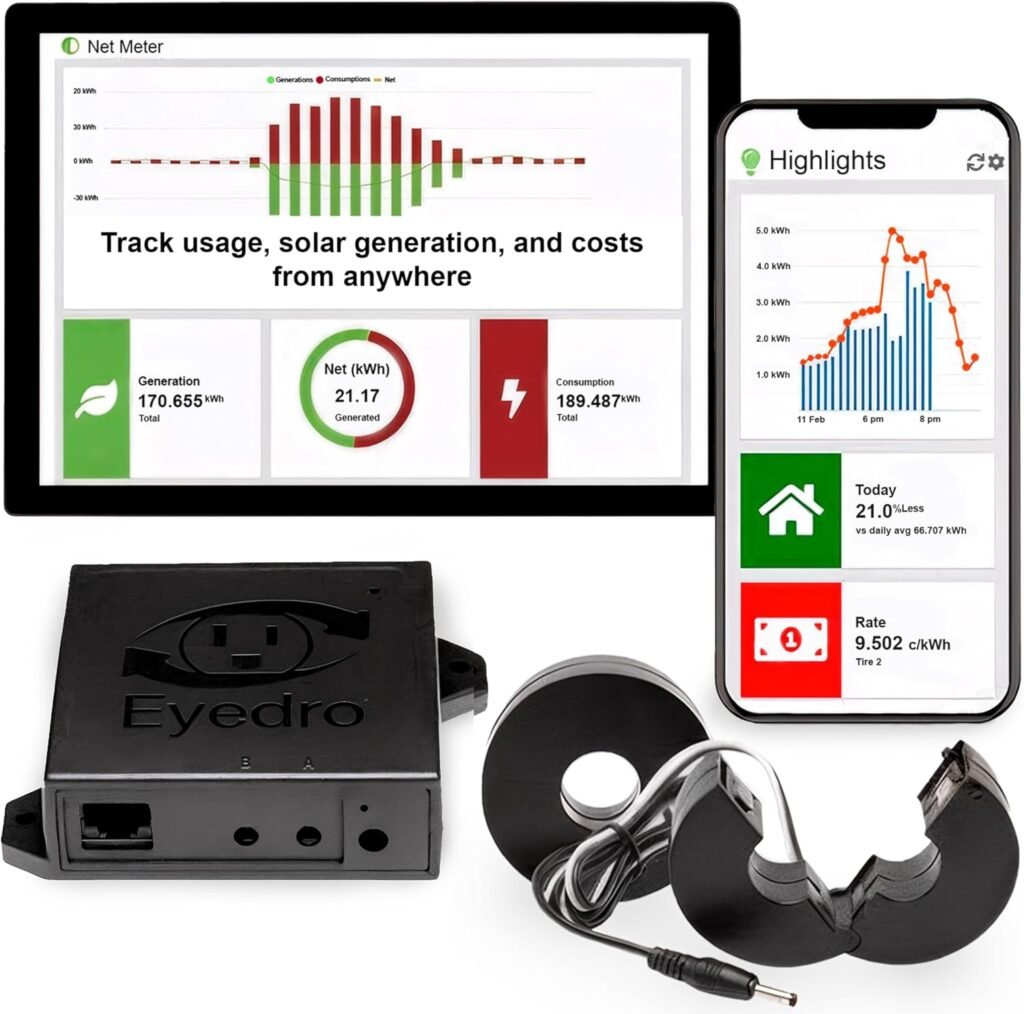
Eyedro is a Canadian company that has been making energy monitors for over a decade, and the EYEDRO-HOME is their flagship home model. It is a solid, no-frills whole-home monitor that does exactly what it promises — real-time electricity monitoring with zero ongoing costs.
The EYEDRO-HOME comes with two 200A current sensors and installs on your home’s main service lines inside the electrical panel. It connects via your choice of 2.4 GHz Wi-Fi or wired Ethernet — the Ethernet option being a standout feature compared to most competitors, as it gives you a more reliable connection without depending on Wi-Fi signal strength at the panel.
Data is sent to Eyedro’s MyEyedro cloud platform, which is free and included with the hardware — no subscription tier or upsell. The cloud dashboard gives you real-time usage, historical data, bill estimates, customizable rate settings, and detailed reports. You can view data in watts, amps, volts, power factor, and dollars.
The EYEDRO-HOME supports solar and net metering, though to separately track both consumption and generation you’ll need two units. It is compatible with Alexa and accessible from any browser without a dedicated app download.
It is not as feature-rich as the Emporia Vue 3 in terms of circuit-level expansion or automation, but for straightforward whole-home monitoring with maximum reliability and zero subscription costs, Eyedro earns its place on this list.
What we like:
- Wi-Fi or Ethernet connection options (Ethernet is rare in this category)
- Completely free cloud access — MyEyedro is included, no subscription ever
- Solid, reliable whole-home monitoring
- Solar and net metering ready
- Trusted brand with over 10 years in the market
What to know:
- Two units needed to separately track both solar generation and grid consumption
- No circuit-level expansion like Emporia’s branch sensor system
- Fewer smart home integrations than Emporia or Sense
- Electrician installation recommended
Bottom line: If you want reliable whole-home monitoring with free lifetime cloud access and a wired Ethernet option, the Eyedro EYEDRO-HOME is a strong choice — especially for solar homeowners.
4. Kasa KP125M Smart Plug — Best Budget / Plug-In Option
Price: ~$39.99 (2-pack) | ~$69.99 (4-pack)
Type: Smart plug / appliance-level monitor
Subscription: None
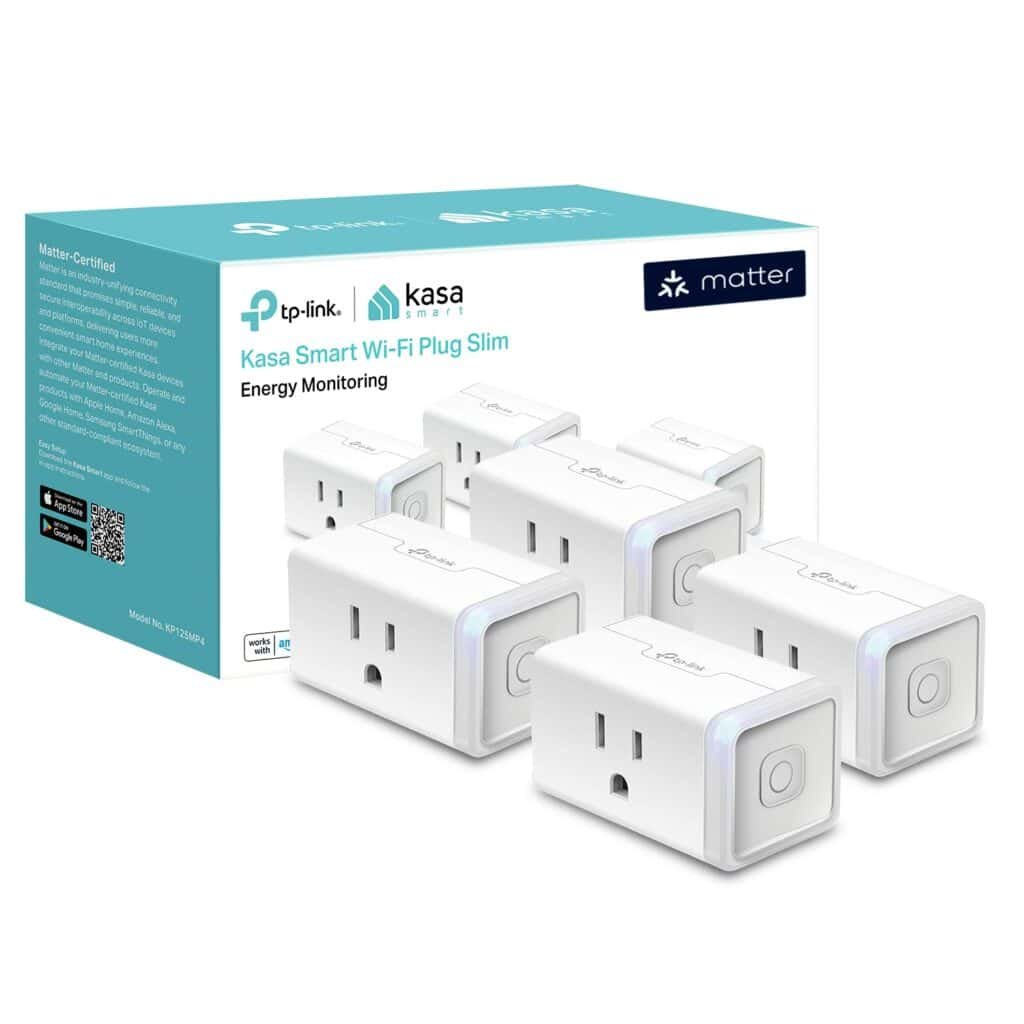
Not everyone needs or wants to open their electrical panel. If you want to start monitoring your energy usage without any installation complexity, the Kasa KP125M smart plug is the easiest and most affordable entry point available.
You simply plug the KP125M into any wall outlet, then plug your appliance into it. The plug measures real-time and historical power consumption of whatever is connected, and sends that data to the Kasa Smart app for iOS and Android. It supports Alexa, Google Assistant, Apple Siri, and Samsung Bixby voice commands. It is also Matter-certified, meaning it works across all major smart home platforms.
The KP125M has a compact, slim design specifically intended to avoid blocking the adjacent outlet — a common frustration with bulkier smart plugs. Each plug handles up to 15A/1800W, making it suitable for lamps, fans, space heaters, televisions, gaming consoles, and similar devices. It is not designed for high-draw hardwired appliances like dryers or HVAC systems.
Energy monitoring data shows real-time wattage, historical usage by day and month, and estimated electricity cost based on your local rate. You can set schedules, auto-off timers, and overload alerts. One note: energy monitoring requires the Kasa app specifically — it is not available through Matter or HomeKit due to current Matter standard limitations.
What we like:
- No installation required — plug-and-play
- Very affordable, especially in multi-packs
- Matter-certified — works with Apple Home, Alexa, Google Home, SmartThings
- Compact design preserves adjacent outlet
- Good app with clear energy data and cost estimates
- No subscription fees
What to know:
- Only monitors individual plugged-in appliances — not your whole home
- Not suitable for large hardwired loads (HVAC, EV chargers, dryers)
- Energy monitoring only works through the Kasa app, not via Matter
- 2.4 GHz Wi-Fi only
Bottom line: The Kasa KP125M is the ideal starting point if you want to identify specific appliance energy hogs without touching your electrical panel. Buy a few and put them on your biggest suspects first.
How to Choose the Right Home Energy Monitor
The best monitor for you depends on three things: what you want to learn, how much you want to spend, and how comfortable you are with electrical panel work.
Choose a whole-home panel monitor (Emporia, Siemens, Eyedro) if: you want to understand your total home energy picture, track large loads like HVAC and water heaters, or have solar panels you want to optimize.
Choose smart plugs (Kasa KP125M) if: you want a simple, no-installation starting point to investigate specific appliances.
Choose Emporia Vue 3 if: you want the best value, plan to expand to circuit-level monitoring over time, or have smart home devices you want to automate around energy usage.
Choose Siemens Inhab if: you want a complete all-in-one system with all 16 circuit sensors bundled in, advanced TOU and solar management features, and the backing of a major established electrical brand.
Choose Eyedro if: you want a reliable whole-home monitor with a wired Ethernet option and zero subscription costs, especially for solar homes where simplicity matters most.
A Note on Installation Safety
Whole-home energy monitors — including the Emporia Vue 3, Sense, and Eyedro — install inside your home’s electrical panel. This involves working near live electrical wires carrying 120/240V of electricity, which can be fatal if handled incorrectly.
While some of these products are marketed as DIY-friendly and include step-by-step instructions, we strongly recommend hiring a licensed electrician for installation. An electrician can typically complete the job in 30 to 60 minutes. Smart plugs like the Kasa KP125M require no electrical work whatsoever.
Frequently Asked Questions
Do home energy monitors require a subscription?
None of the monitors in this guide require a paid subscription. App access, cloud storage, and data are included free with the hardware for Emporia, Sense, Kasa, and Eyedro.
How much can a home energy monitor actually save me?
Results vary, but Sense reports average users save around 8% on their electricity bill. Emporia states the average homeowner can save 10% or more monthly. Savings depend on what energy waste you discover and whether you act on the data.
Will a home energy monitor work with solar panels?
Yes. The Emporia Vue 3, Sense Solar, and Eyedro EYEDRO-HOME all support solar monitoring and net metering. The Emporia Vue 3 and Sense Solar versions track both consumption and solar generation simultaneously.
What Wi-Fi does a home energy monitor need?
Most monitors, including the Emporia Vue 3 and Sense, require a 2.4 GHz Wi-Fi network at or near your electrical panel. The Eyedro EYEDRO-HOME additionally offers a wired Ethernet option if Wi-Fi signal at the panel is unreliable.
Can I install a whole-home energy monitor myself?
Some manufacturers market these as DIY-installable, and technically capable homeowners have done so. However, working inside a live electrical panel carries serious safety risks. We recommend hiring a licensed electrician, which typically costs $100–$150 for the installation.
What happened to the Sense Energy Monitor?
Sense stopped selling its hardware monitor as of December 31, 2025. The company has pivoted to embedding its software in next-generation utility smart meters through partnerships with providers like National Grid. Existing Sense monitors continue to be supported, but new hardware is no longer available. Sense itself recommends Emporia as an alternative for buyers seeking a hardware monitor.
Final Verdict
For most homeowners in 2026, the Emporia Vue 3 is the best home energy monitor you can buy. It starts at $99, scales with your needs, supports solar, has no subscription fees, and is backed by a strong app and growing smart home ecosystem.
If you want a complete all-in-one system with every sensor included and advanced energy management for TOU rates, solar, and EV charging, the Siemens Inhab is a compelling premium alternative — and the trusted Siemens name carries real weight for homeowners who want an electrician-grade product.
For those who want Ethernet connectivity and absolutely zero ongoing costs, Eyedro is a proven choice. And if you just want to start somewhere easy, a pack of Kasa KP125M smart plugs will tell you more about your energy usage in a weekend than a year of utility bills.
Any of these monitors will pay for themselves if you use the data to make even small changes to how and when your home uses electricity.
Affiliate Disclosure: Some links are affiliate links, meaning we may earn a commission if you purchase—at no extra cost to you. Prices and availability can change. We base our content on independent research, not direct input from manufacturers or utilities unless stated. Unless explicitly stated, we do not personally test every product. Our reviews are based on independent research, product documentation, and user/reviewer feedback.